Saturday, 27 May 2017

Observing Differentiated Instruction's Affect on Student Engagement


One of the more challenging ideas that I am learning in class is how to differentiate instruction, while identifying the same objectives for different groups of learners. It is helpful to observe how my associate teacher is able to implement it during her lessons. For example, during a recent lesson on Halloween vocabulary she used a differentiation of instructional strategies: she wrote the words on chart paper, read the words together with the students, asked them to write the words on their own, baked with their assistance cookies shaped like the words, and directed them to storybooks which contained many of the words.


I recognized that she was differentiating according to the four categories - cognitive, intellectual, group orientation and environmental - that we learned in class. By the end of the activities, the students had improved their abilities to read and write the words, and I could sense that they enjoyed their learning. It is clear that effective DI can engage students.

Tuesday, 23 May 2017

Student Engagement Drops With Each School Year


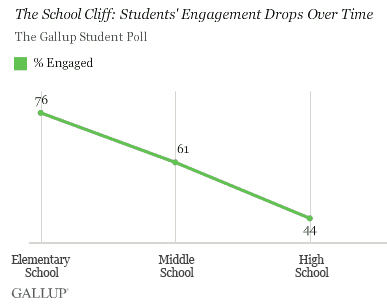
My motivation for tackling the topic of student engagement stems from seeing the following Gallup Student Poll Survey which asked nearly 500,000 U.S. students from grades 5 to 12 about whether they are engaged with their school.


Link: The School Cliff: Student Engagement Drops With Each School Year

What is alarming about this large study is that it not only indicates a steady decline in engagement as students progress from elementary to high school, but it also implies that one-fourth of students in grades 5 and 6 are not engaged. Therefore, significant disengagement is occurring at even the primary grades.

Although the survey was conducted among U.S. students, my sense is that student sentiment is similar in Ontario. In order to be a successful educator, I need to draw on my classroom and field experiences to search for and determine the causes and solutions for this problem. The purpose of this blog is to serve as a place where I can curate my experience and reflect on my findings.