Saturday, 8 July 2017

Motivating Students Through Inquiry-Based Learning


We have discussed in class how the constructivist approach where students are active learners can offer a more enriching learning experience than the traditional approach. One way students can actively acquire knowledge is through inquiry-based learning where students investigate their own questions or problems with teachers serving only as facilitators. Learning based on natural curiosity can engage students. Although I find inquiry-based learning effective, I am not sure that students will be able immerse themselves in it to any great length given the curriculum expectations that need to be addressed. In this regard, I have found the following MOE document, which lists some guiding principles for creating a responsive learning community, to be a valuable resource.

Link: https://www.edu.gov.on.ca/eng/literacynumeracy/inspire/research/CBS_InquiryBased.pdf

Thursday, 6 July 2017

The Importance of Students' Ownership of Their Learning Environment

In our class readings about being a culturally inclusive educator, we examined the idea of Transformative Learning, and how its student-centered approach gave students ownership of their learning. The MOE, through its Capacity Building Series publication, details how it is supporting student voice and suggests that teachers can do the same by fostering reciprocal relationships. This requires a growth mindset and can be accomplished by involving students in shaping their learning environments, learning opportunities, and assessments. As students gain greater voice, teachers are discovering that they can be trusted to work and learn with their peers.


The following photo is an example of how my associate teacher displays her students' work to remind them of their creative ownership of their learning environment.


Wednesday, 5 July 2017

Assessment as Learning Demonstrated by a Class Drama


From the Ministry of Ontario resources, I found a video clip of a drama presentation by a group of high school students who decided to explore what makes them engaged or disengaged in their learning.  Initially, their teacher asked them to write down their thoughts in response to 4 simple prompts:


I need...
I don’t need…
The best…
The worst…


From only their responses the students created a performance that reflected their feelings about school. Throughout the process, assessment as learning occurred as they discovered which factors support and hinder their academic performance, and they gained a better understanding of the teacher's perspective.


Watching this video can also help educators appreciate some of the needs of their students and the challenges that they face. It also shows how drama can be used as a self- and peer-assessment tool.


Link: http://www.curriculum.org/k-12/en/projects/student-engagement

For more about effective assessment practices that can be used to teach arts, see this blog created by a certified teacher.


Thursday, 29 June 2017

Can Video Games be Used for Learning in the Classroom?

Can teacher's leverage students' interest in video games to achieve positive learning outcomes? A couple of researchers investigate the answer in a publication by the Literacy and Numeracy Secretariat. Their conclusion is that teachers can boost student engagement levels by presenting them with math and literacy lessons using well-selected computer or iPad games that offer a context for adaptive learning and constructivist learning through an online community of players, while also utilizing their problem solving skills and creativity. The key, however, is selecting appropriate games. The following article offers some recommendations.


Monday, 19 June 2017

Ensuring Safety for Student Engagement

Student engagement can only occur if students feel that their learning environment is safe and supported. The following professional advisory by the OCT informs its members of their responsibilities to ensure a safe learning environment.

Link: https://www.oct.ca/Home/Resources/Advisories/Safety 

The OCT lays a framework for dealing with safety in learning environments using the 3 R's of Recognize, Report, and Reflect. 

When completing my Focused Observation Booklet, I examined how my associate teacher ensured safety for her students. The first photo below are the classroom rules that were created to prevent accidents and conflicts with peers. They are clearly written and posted on an easily visible part of the wall. The second photo below is of her lesson during Bullying Awareness and Prevention Week.


Sunday, 11 June 2017

Parent Engagement is Key to Student Engagement

As a parent, I can understand the importance of parent engagement on student achievement. I find that by volunteering at my children's school, meeting with their teachers, and asking them about their school day I am better able to support their learning. Also, showing an interest in their education motivates them to impress me with their learning.

However, I am aware that there are barriers to parent engagement such as language, single parenthood, parent educational level, and cultural influences. The following document lays a policy framework for engaging parents in their children's learning. Essentially, it acknowledges the importance of parent voice by providing multiple ways for parents to express their views and receive responses from educators.

Link: http://www.edu.gov.on.ca/eng/parents/involvement/pe_policy2010.pdf

Saturday, 27 May 2017

Observing Differentiated Instruction's Affect on Student Engagement


One of the more challenging ideas that I am learning in class is how to differentiate instruction, while identifying the same objectives for different groups of learners. It is helpful to observe how my associate teacher is able to implement it during her lessons. For example, during a recent lesson on Halloween vocabulary she used a differentiation of instructional strategies: she wrote the words on chart paper, read the words together with the students, asked them to write the words on their own, baked with their assistance cookies shaped like the words, and directed them to storybooks which contained many of the words.


I recognized that she was differentiating according to the four categories - cognitive, intellectual, group orientation and environmental - that we learned in class. By the end of the activities, the students had improved their abilities to read and write the words, and I could sense that they enjoyed their learning. It is clear that effective DI can engage students.

Tuesday, 23 May 2017

Student Engagement Drops With Each School Year


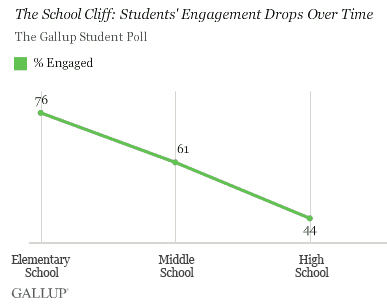
My motivation for tackling the topic of student engagement stems from seeing the following Gallup Student Poll Survey which asked nearly 500,000 U.S. students from grades 5 to 12 about whether they are engaged with their school.


Link: The School Cliff: Student Engagement Drops With Each School Year

What is alarming about this large study is that it not only indicates a steady decline in engagement as students progress from elementary to high school, but it also implies that one-fourth of students in grades 5 and 6 are not engaged. Therefore, significant disengagement is occurring at even the primary grades.

Although the survey was conducted among U.S. students, my sense is that student sentiment is similar in Ontario. In order to be a successful educator, I need to draw on my classroom and field experiences to search for and determine the causes and solutions for this problem. The purpose of this blog is to serve as a place where I can curate my experience and reflect on my findings.